


Seoul: a new level of accessibility
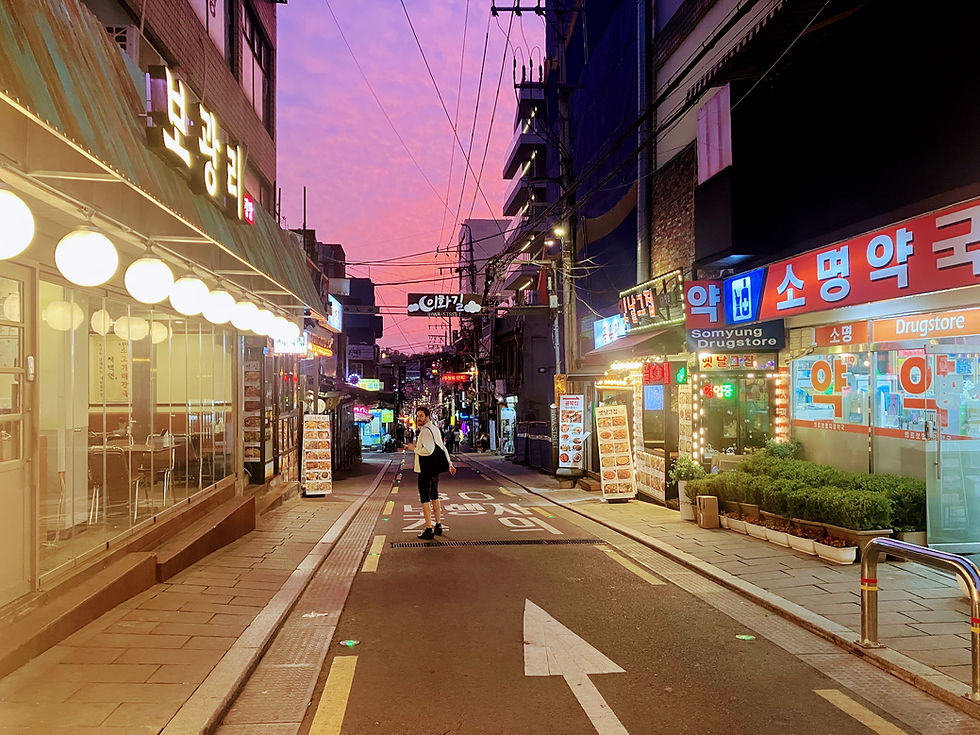
I recently had the fortune to to visit South-Korea as a tourist. My imaginary of the country was largely built on a few Kim Ki Duk films I'd seen in my late adolescence, on Bong Joon Ho's "Parasite" and more recently, on Han Kang's fascinating novel "The Vegetarian". I was initially afraid of spending many days in the capital city, given that it is a megalopolis of 26 million inhabitants. As a person who is fairly sensitive to noise and sensory overload, I feared becoming quickly overwhelmed by the city. I recall a brief visit to Hong Kong around 2013 when, after spending two hours in the city, I had to seek refuge in a park for the rest of the day as I could no longer take its intensity. Medellín and Bogotá, also big cities, were much the same for me -fascinating, but draining. So I was mentally prepared to become exhausted, but the experience was very much the contrary. I couldn't stop asking why Seoul feels so easy and why I was not drained even after three days of intensive walks, visits to markets, all sorts of neighbourhoods, temples, etc. So in this post, I'm gonna share a few thoughts on what makes this huge city accessible both physically and mentally.
Active travel
We began our trip in Songdo, Incheon, which is technically not part of the city of Seoul, but does belong to its metropolitan area. Songdo is an example of many other new cities that have been built from scratch in the last 20 years in order to easen the housing and mobility crisis that Seoul has experienced for decades. Songdo has been positioned as a smart and green city that aims to attract foreign investments though its Free Economic Zone policies. While this has not been thoroughly succesful (foreigners count for about 5% of all population), the built environment felt surprisingly humane in the few parts that we visited. And this probably has to do with a) very wide sidewalks and b) plenty of green areas. In fact, about 40% of its total area is dedicated to green space.
As for facilitating active travel, Songdo had zero high curbstones that would obstruct movement for wheelchairs, bicycles and prams. Also, there are plenty of rest spaces with shade, and sunshades are even placed at street crossings so that pedestrians could keep out from the heat in the warmer months. These seem to open and close automatically according to the weather. There are also plenty of bike lanes that look gorgeous, but empty-ish (Korea is, after all, a major car manufacturer).

Care infrastructure
I did not expect this nor could I even dream of some of the infrastructure I saw, but Seoul is VERY child and caretaker friendly. Seats for caretakers are marked in pink color on all the buses. There are small sheds for strollers in front of daycare places. Public toilets are absolutely everywhere and very clearly signed. Not only are they super clean, but they all had diaper changing facilities, adapted sinks and toilet seats or a stool to step on. Many toilets also had special emergency buttons for whatever unexpected occasions. What is more, I saw two amazing breastfeeding rooms, both of them located in public museums that have free access. Nursing rooms were even available in many metro stops that also had the cleanest toilets. Amazing not only for women on their periods but alsow for the elderly and people with all sort of health issues that may require more frequent toilet use.
We happened to be in the city on the 5th of May, which was celebrated as the International Day of Children. For the occasion, the whole plaza next to the City Hall was cleared up and filled with beanbag-beds where people could rest. Books were disposed freely for everyone to read without having to register or give anything in return. You just trust that people won't walk away with them.
Signs and advertisements
Now this is a slightly different topic that I am not well versed with, but one that has a strong relationship with accessibility. Koreans love to sign and give warnings literally everywhere and for all sorts of "dangers" that seemingly threaten us in the urban environment. This being said, Seoul is actually an extremely safe city and their crime rates have decreased drastically in the last 10 years. This probably has to do with increased well-being, as well as hyper-vigilance through the use of CCTV cameras that are bsolutely everywhere. So in a way, one is always surveilled and little room is left for any kind of wrong-doing.
As for the amount of street signs and especially the public safety videos played in the subway, we couldn't help but wonder if the vigilance-obsession also has to do with their northern neighbour who represents a constant threat and has perhaps justified the need for surveillance. The "genre" of subway videos included indications on how to deal with a rude co-traveller, how to put off a fire, or act in case of toxic air pollution. The videos were often done in a friendly, sometimes childish way, yet the message was clear: be alert and act collectively. What looked like a whole new genre to me, was the video displayed in Seoul's central station, where steep stairs lead to train platforms that take you to the airport. So the stairs are frequently used by tourists with heavy luggage. In the massive screen that we were facing when descending to the fast trains, a film using real life CCTV footage showed us how a big suitcase fell down the stairs and knocked off a woman-traveller, causing severe damage. All of that to tell us to hang on to our luggage at all times to avoid criminal chargesbeing pressed at the occasion of an accident. That was really quite dramatic. As are the below static signs that I managed to photograph in different parts of Seoul and Jeon-Ju.
Aside from these observations on the somewhat excessive instructions that are also emitted acoustically, Seoul is a fascinating city. I look forward to going back there, hopefully with a more professional goal as I would love to learn about their urban planning history, especially since so much of what we saw has been constrcuted in a mere 50 years.


